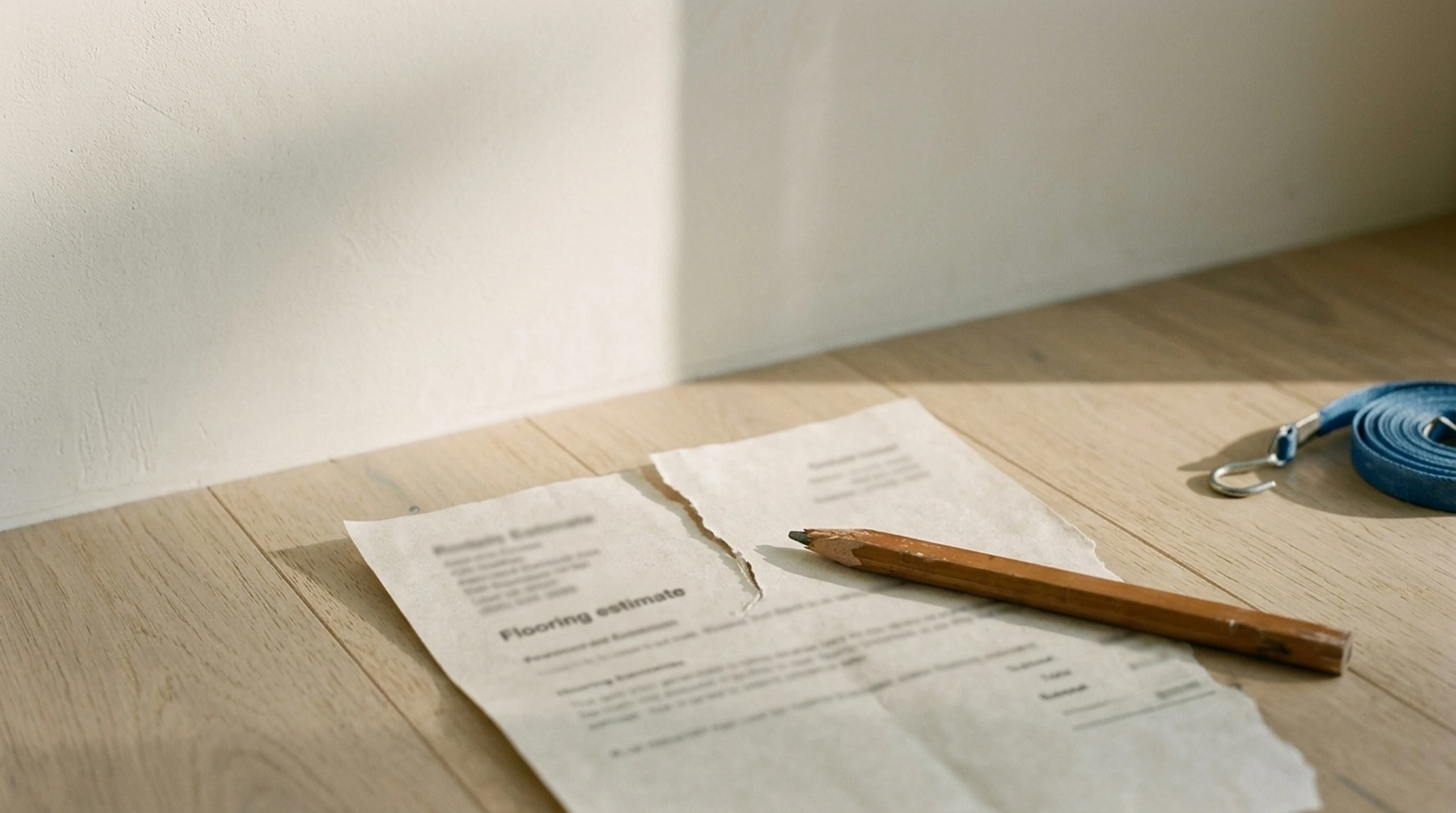
Most bad flooring jobs do not fail because a worker forgot how to click planks together. They fail because the risky parts of the job were rushed, skipped, or left vague: moisture testing, leveling, trim details, perimeter movement, and change-order communication. The early warning signs are usually visible before the whole house is finished. If you’re evaluating a flooring contractor in Sarasota, the patterns below show up consistently in jobs that go wrong before they’re even finished.
What homeowners should know
A shortcut often starts before the first plank goes down. If the estimate talks at length about the product but barely mentions prep, that is a warning sign. Current installation guides for wood, laminate, and rigid-core vinyl all call for jobsite evaluation, substrate prep, and moisture testing. A contractor who treats those steps as optional is not following the documents that protect the homeowner later.
Public complaint threads repeat the same themes. Homeowners describe floors that feel wavy, sound hollow, gap early, show damaged edges, or end up pinned too tightly at walls and trim. They also describe jobs that looked affordable until the crew suddenly announced that leveling or moisture work would cost much more.
Why shortcuts fail faster in coastal Sarasota homes
Local homes can make shortcuts show faster. Large sliders and strong sun make unevenness and sloppy transitions more visible. Coastal entries bring sand and wet traffic that stress weak seams. Seasonal vacancy can magnify movement problems if the floor was installed without serious attention to moisture and indoor conditions.
The risk is even higher in homes with prior leaks or storm history. On Longboat Key or Siesta Key, an installer should sound more careful, not less, when discussing prep and moisture.
What to look for / ask / avoid
Watch for these red flags:
- No written plan for moisture testing
- No clear statement of who pays for substrate prep and when that cost is approved
- Vague answers about flatness, leveling, or slab cracks
- No discussion of expansion space around walls, islands, or sliders
- Damaged planks being installed anyway
- Transitions and baseboards treated like a cleanup problem instead of part of the plan
Ask to see the selected product’s installation guide. Then ask how the crew is meeting it in your rooms, not in theory.
Common mistakes or contractor shortcuts
One common shortcut is skipping or failing to document moisture readings. Another is treating floor leveling as an optional upgrade instead of a prerequisite. A third is weak transition and trim planning, which shows up later as awkward thresholds, visible gaps, or floors trapped too tightly at the perimeter.
Homeowner complaint threads also show a cosmetic shortcut: reusing damaged boards or keeping chipped edges in the field where they are easy to spot. In high-end open spaces, those shortcuts stand out.
There is also a communication shortcut. Some added prep cost is legitimate once demo exposes the substrate. The problem is when the original estimate gave the homeowner no useful picture of what was included, what was excluded, and what would trigger a change order.
Bottom line
A careful flooring contractor usually sounds specific about the unglamorous parts of the job: testing, prep, movement, trim, and paperwork. That is a good sign. A contractor who mainly talks about speed, product hype, or how “it will be fine” is asking the homeowner to take the risk instead. See our flooring contractor services to understand what a scope-forward estimate looks like, or review what a complete hardwood floor installation in Sarasota proposal should cover.