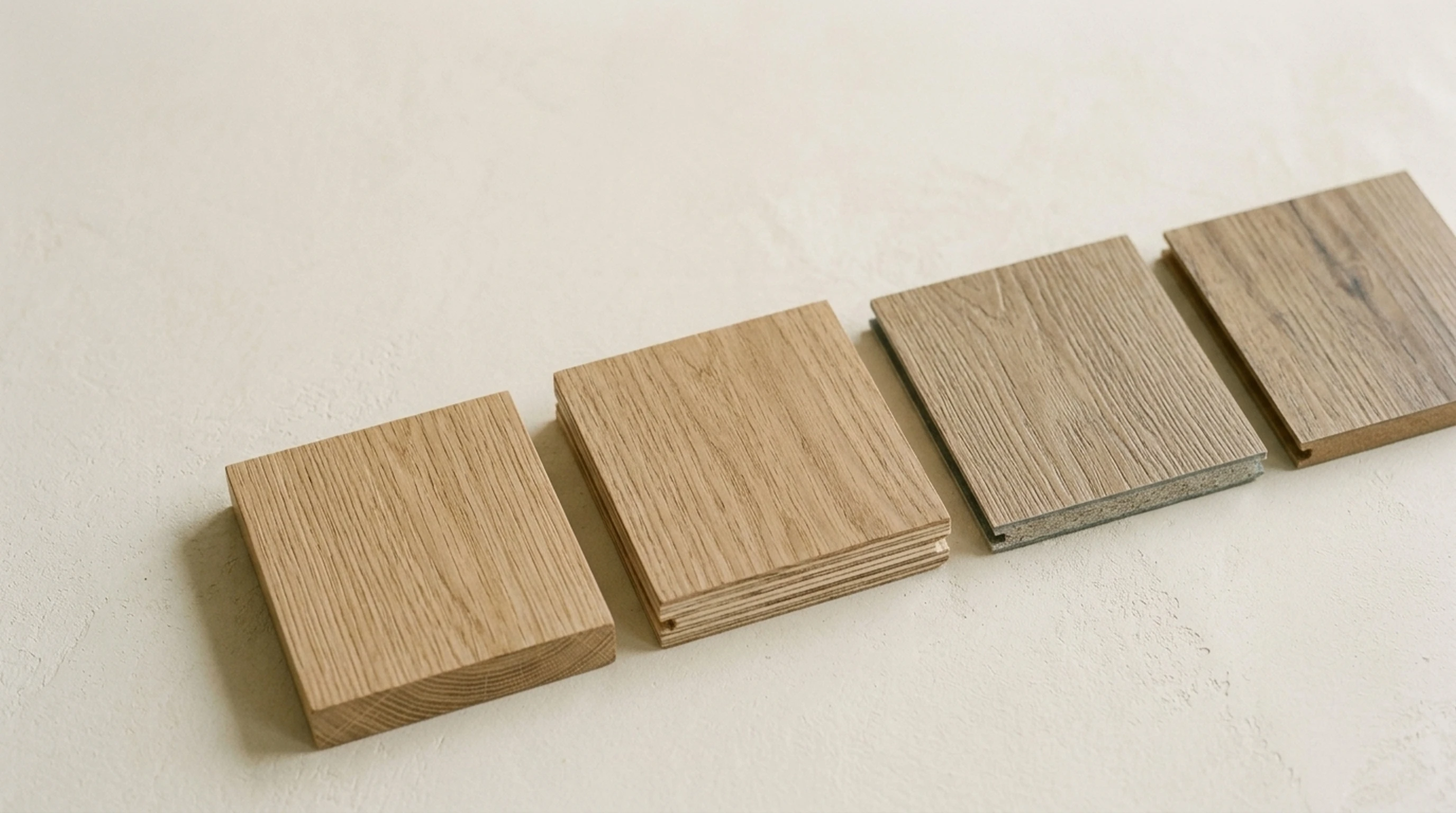
No single floor is best for every Sarasota-area home. The right choice depends on the room, the house’s water history, how the home is conditioned when nobody is there, and how much sand, wet traffic, and direct sun the floor will see. Solid hardwood still works in the right spaces. Engineered hardwood usually gives wood lovers more flexibility. LVP is often the practical choice near entries, pets, and pool traffic. Laminate can be a sensible value option in conditioned rooms, but it is not the same thing as vinyl plank.
What homeowners should know
Solid hardwood is cut from a single piece of wood. It can look excellent and can often be refinished, but the installation rules are strict. Bruce limits solid wood to on- or above-grade use — meaning above ground level, not in a basement — and requires steady indoor temperature and relative humidity. That makes it a better fit for dry, conditioned living spaces than for risky coastal rooms.
Engineered hardwood has a real-wood top layer over a layered core. That layered construction makes it dimensionally stable — meaning it holds its shape better through humidity swings than solid wood, which is why engineered products often make more sense in Sarasota homes with wider rooms or moderate seasonal movement. Dimensionally stable does not mean waterproof. Flood history, repeated slider leaks, or poor humidity control can still damage it.
Prefinished vs. site-finished hardwood
Prefinished boards arrive factory-coated, which means faster installation and no on-site sanding dust. Site-finished hardwood is sanded and sealed after installation, which allows custom stain colors and a seamless surface with no micro-bevels between planks. In Florida, prefinished is more common for new construction. Site-finished is typical in high-end remodels where a specific stain match or a truly seamless look matters most. Ask your installer which approach fits the room — and the timeline.
LVP, or luxury vinyl plank, is usually easier to live with where the floor sees wet feet, pets, or frequent cleaning. The surface may be waterproof, but the installation guides still require moisture testing, flat substrates, expansion planning, and often a poly layer over concrete. A waterproof plank does not cancel a damp slab.
Laminate is its own category. Modern laminate can be a good fit in conditioned rooms where the owner wants durability and value without paying for real wood. It still needs moisture control and expansion space, and it is not the first choice for rooms that stay wet.
Why location and vacancy patterns change the answer for Sarasota homes
The local decision is not just “Florida humidity.” Sarasota County’s March 27, 2024 flood-map update matters because some homes, especially around Longboat Key and parts of Siesta Key, face a different water-risk picture than inland neighborhoods. Longboat Key’s evacuation exposure and post-storm rebuilding conversations after Helene and Milton make prior water intrusion part of the flooring decision.
Seasonal occupancy matters too. UF/IFAS and Florida Solar Energy Center guidance both point to the need for real humidity control in vacant homes. Florida hardwood flooring — whether solid or engineered — is especially sensitive to this: a coastal house left warm and muggy for months can stress wood and laminate more than a full-time occupied Lakewood Ranch home with steady indoor conditions. Inland homes still need moisture testing and prep, but they usually have less direct coastal exposure.
What to look for / ask / avoid
Ask these questions before choosing a material:
- Is the room above grade, on a concrete slab, or near an exterior slider?
- Has the house had flooding, repeated leaks, or prior moisture repairs?
- Will the home stay conditioned year-round, even when vacant?
- How much sand, wet traffic, or pool use should the floor expect?
- What do the selected product’s own installation and warranty documents say?
Avoid choosing by showroom appearance alone. Two floors can look equally good on a sample board and behave very differently in a barrier-island house with storm history or a seasonal home with high summer humidity.
Common mistakes or contractor shortcuts
One mistake is treating all wood floors as the same. Solid hardwood and engineered hardwood are not interchangeable. Another is assuming a waterproof vinyl plank means the whole floor system is protected. It does not. Slab moisture, flatness, and perimeter movement still matter. A third mistake is ignoring how the house lives when the owner is away. Vacancy settings can change the right answer.
Bottom line
For Sarasota-area homes, engineered hardwood is often the safer wood option, LVP is often the easier everyday option, laminate can be a smart value option in conditioned rooms, and solid hardwood still works in the right spaces when the house is managed correctly. The better next step is a room-by-room decision based on moisture risk, vacancy pattern, and subfloor condition.
Florida hardwood flooring — whether solid or engineered — performs differently here than in northern or western markets. The humidity, slab conditions, and coastal exposure that define Sarasota-area construction demand an installer who understands how material choice, prep, and installation method interact with local conditions.
For a deeper look at solid and engineered options, including prep requirements and installation methods specific to this area, see our Florida hardwood flooring installation page.